
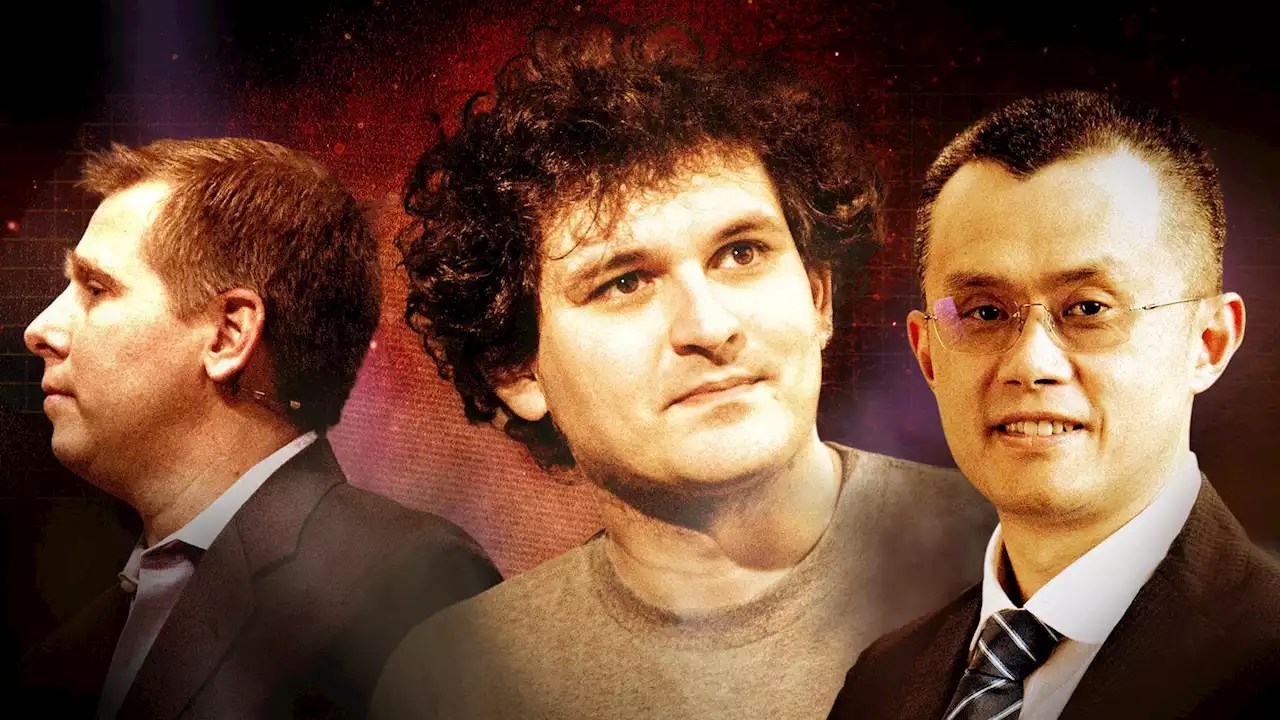
In January 2022-23, Sam Bankman-Fried was on a high. The Bahamas-based FTX had just received $400,000 from prominent venture capitalists for an estimated $32 billion value. Then, a few weeks later, when Forbes released the year-end World’s Billionaires list, SBF is known as SBF. was the second-highest crypto-related person with a value of $24 billion.
The Bankman-Fried of today is probably broken and waiting for his trial. When he was detained in the Bahamas, SBF told several media outlets that his bank account was at $100,000 and that the bank wasn’t “not sure” how he’ll pay his lawyers. Gary Wang, FTX’s other cofounder and former chief technology officer, who entered an agreement with the Securities and Exchange Commission, has also seen his fortune, which was once estimated to be $5.9 billion, disappear.
The demise of FTX was a fitting ending to a decade of the devastation of wealth in the blockchain and cryptocurrency sector. The post-pandemic economic shock that led to inflation and increasing interest rates took capital from the speculative cryptocurrency market. Some of the most prominent firms collapsed, starting with the collapse of $40 billion in the May issue of the algorithmic stablecoin TerraUSD and the hedge fund for crypto Three Arrows (which declared for bankruptcy in July) and the bankruptcy of interest-bearing lending companies Voyager Digital, Celsius and BlockFi. Bitcoin, The largest cryptocurrency and a bellwether for the industry, has dropped 66% from its $69,999 highest at the end of November 2021. In addition, around $2 trillion in market value has escaped digital assets in search of more secure places to live.
In the end, 17 of the most wealthy crypto founders and investors have collectively lost around $116 billion of personal fortune since March, according to Forbes estimations. Fifteen are losing more than 50% of their fortune in the last nine months. Ten have lost their billionaire status completely.
“We’re now at the breaking point in crypto where everyone will have to pause and say, ‘Okay, we’ve seen a ton of economic wealth destroyed in the last couple of months. We need to start taking this seriously,'” says Matt Cohen, founder of Ripple Ventures, a venture capital company. “A lot of blockchain technologies and crypto companies built solutions for problems that didn’t need fixing, and I think we’re now going to have a hard reset.”
The person who has the most at stake has the most to lose is Changpeng Zhao, CEO of Binance, the largest cryptocurrency exchange. It’s a sprawling network of shady subsidiaries. CZ is his name as, holds an estimated 70 per cent stake in Binance and has Forbes estimates at $4.5 billion, down from $65 billion as of March.
CZ set the fate of FTX in motion on the 6th of November when he announced that Binance would sell their remaining FTT, the primary cryptocurrency of FTX. The tweet triggered a rout in the FTX’s funds as customers scrambled to cash out their funds only to find they had no money. FTX filed for bankruptcy just within a couple of days. Zhao was able to prevail over his rival. However, he now has to face the consequences. It could be a recovery in the bankruptcy court of more than $2.1 billion Binance earned through the sale of its share of FTX and transferring it 2021 to Bankman-Fried during the spring of 2021. (Zhao contributed to the seeding of FTX in the year 2019.)
CZ is also facing increased suspicion of central exchanges, including Binance as well as ongoing investigations into CZ and his company from authorities across Europe as well as leaders in the United States over allegations of aiding in the laundering of money and other financial criminal acts. (Binance has denied any wrongdoing.) In recent months, CZ has sought to assure Binance customers that their crypto deposits are secure and has commissioned the accounting firm Mazars to create “proof of reserves” reports. These reports are not inclusive of liabilities and have been widely criticized as insufficient to provide an inadequate picture of a business’s financial health. Mazars has since suspended the work it does with crypto companies and has increased the uncertainty surrounding Binance’s finances and the future of the exchange.
“I don’t believe a business can persist, operating in this amorphous way, not governed by anyone or anywhere, especially when a public individual runs it,” says Lisa Ellis, an equity analyst at MoffettNathanson, a division of SVB Securities. Its “dodgy operating model” would be a “non-starter for many investors, public or private,” says Ellis.
CZ declared in a webcast on the 23rd of December that Binance has no liabilities: “We are quite a unique organization. We don’t have loans from any other organizations,” he stated. “We will prove all the FUD [fear, uncertainty and doubt] is wrong.” A spokesperson for Binance said that Forbes estimated the net worth of CZ is “not an important metric to CZ. More important is creating real-world use cases for cryptocurrency.”
Barry Silbert, head of the crypto group Digital Currency Group, is at the forefront of the market’s contagion in crypto. One of DCG’s main assets, the crypto lending division Genesis Global Capital, owes creditors a minimum of $1.8 billion, as per insider knowledge about the issue (and in the manner that Reuters first announced). In addition, DCG is saddled with debt. It took on the $1.1 billion obligation from Genesis due to a failed loan Genesis had given to the bankrupt Three Arrows hedge fund. In addition, DCG owes Genesis another $575 million that will be due by May. According to the Financial Times report, DCG is also owed $350 million by the investment company Elridge in the event that Genesis becomes insolvent at the threshold.
To remain on the right track, Silbert will likely have to raise additional capital from the outside or cut down the DCG Crypto empire. This comprises around 200 investments in crypto companies and tokens. These include crypto news website CoinDesk and bitcoin mining company Foundry and Grayscale Investments, an asset management company which offers shares in an exchange-traded Bitcoin trust. Forbes estimates that DCG’s outstanding liabilities are higher than the value it can realize in the present economic climate; DCG may also need help to get rid of bets that aren’t liquid. This is why Forbes estimates the current value of Silbert’s stake of 40% of DCG to be around $1.00. Silbert’s investments cannot be ascertained. The spokesperson of DCG did not respond to requests for comment.
“They faced a problem with solvency at Genesis, which turned into liquidity issues. But the losses aren’t going away,” says Ram Ahluwalia, the CEO of the crypto-focused Lumida Wealth Management, who insists it is likely that Genesis creditors will be able to claim on DCG assets, even when Genesis is declared bankrupt. “If DCG doesn’t raise fresh equity capital, it will be perceived as a zombie business.”
Cameron, as well as Tyler Winklevoss, the bitcoin billionaires immortalized in The Social Network for their contribution to the creation of Facebook and growth, are also in Silbert’s lending network. Gemini, the twins’ privately-owned crypto exchange, gave customers returns of up to 8 per cent during the bull market with its Gemini Earn product. The company contracted the loan-making process to Genesis. Currently, Gemini customers are owed $900 million from Genesis. On the 16th of November, Genesis shut down withdrawals, which left customers furious. Gemini Dollar, the exchange’s stablecoin and the main component of Gemini Earn’s loan program has seen massive outflows. The Winklevii remain silent except for a few sparse tweets about Gemini creating a creditor committee.
For Brian Armstrong, the chief executive of Coinbase, a publicly traded exchange Coinbase the collapse of FTX was the chance to make a statement. On the 8th of November, amid the chaos after Binance announced its plan to take over from FTX, Armstrong trumpeted his idea of crypto’s future while pointing out Binance’s Zhao. “Coinbase and Binance follow different paths. We’re trying to adopt the regulated, trustworthy method,” Armstrong said on the Bankless podcast. “To think about it truthfully, we’re choosing to adhere to the guidelines. This is a harder approach and at times your hands are tied but I think it’s the best long-term plan.” In the same 13-tweet post that morning, Armstrong repeated these themes.
Investors aren’t too concerned. Coinbase’s stock has fallen 64% since the end of August and has risen more than 95% since its 100 billion IPO in April 2021. It has erased the bulk of Armstrong’s wealth.
In the meantime, Coinbase’s cofounder Fred Ehrsam got killed by Bankman-Fried. The crypto venture company he founded, Paradigm, made a $ 278 million investment in equity in FTX. Ehrsam has not made any public statements regarding the investment. Matt Huang, Ehrsam’s partner at Paradigm and Paradigm, wrote via Twitter: “We feel deep regret for having invested in a founder and company who ultimately did not align with crypto’s values and who have done enormous damage to the ecosystem,” adding that Paradigm’s equity stake in FTX “constituted a small part of our total assets” and Paradigm did not ever entrust FTX to manage one of its digital assets.
Private crypto companies that have received capital from 2021 earlier in the year at high prices are trading at substantial discounts on secondary markets as well as in deals that are over-the-counter, says Matt Cohen of Ripple Ventures and expects more significant markdowns in the fourth quarter, as firms prepare their year-end reports for investors. “Q4 audit season is going to be the time when the rubber meets the road on what funds are going to be marked down properly,” Cohen declares.
For instance, the Shares from NFT exchange OpenSea are trading at a discount of 75% in January, after OpenSea reached a $13.3 billion value, as per data obtained from market-data platforms private to the public ApeVue as well as Cap light. Daily trade volumes on OpenSea’s NFT exchange are below $10 million for the last month, as opposed to more than $200 million in January, as per the crypto website DappRadar. The co-founders of OpenSea, who are in their 30s, Devin Finzer and Alex Atallah, are no longer billionaires.
Nikil Viswanathan and Joe Lau, The founders of Alchemy which is a software company that is the backbone of various Web3 projects, have quit the three-comma club according to estimates of markdowns on the stakes they hold in Alchemy which was last able to raise external capital back in February, at a $10.2 billion value. According to Viswanathan, the collapse of FTX “hurts the perception of consumers about the cryptocurrency market. This has been seen through both the Lehman Brothers and Bernie Madoff collapses in 2008 — and it takes time to heal.” Alchemy, however, has continued to grow even during the downturn, according to Viswanathan. “The difference is in Web3, we’ve seen developer activity accelerate during even the most tumultuous times, which points to a powerful, mission-driven community of builders.”
Jed McCaleb, the co-founder of cryptocurrency firm Ripple, is thought to be the only person to have made a fortune through crypto that kept the majority of his wealth throughout the downturn. It’s because he sold out nearly entirely before the market crash. McCaleb sold around $2.5 million worth of Ripple’s native currency between December 2020 and July 2022, fulfilling the separation agreement he had signed with the company’s other founders back in 2013. At present, XRP is traded at around $0.40 per coin, a drop of approximately 50% from earlier in the year, when McCaleb was disposing of millions of dollars worth of XRP tokens weekly.
Chris Larsen, Ripple’s other chairman and founder Chris Larsen, the company’s other founder and chairman, has suffered losses of more than a billion this year because of XRP’s decline and Forbes’s estimates of a discount to Ripple’s equity value. Ripple raised capital in 2019 with a value of $10 billion and purchased back shares from investors in 2018 at an overinflated $15 billion value after the investor filed a lawsuit against Ripple in connection to a Securities and Exchange Commission lawsuit that the Securities and Exchange Commission filed against Ripple in December of 2020 the case is in the process of being heard by the court.
Tim Draper, a venture capitalist with approximately 30,000 bitcoins, was ejected from the billionaire club at the beginning of the year when Bitcoin reached $33,000. However, Draper remains optimistic about bitcoin’s future, even if his frequently-repeated price goal of $250,000 appears more unlikely as the days go by. “I suspect that this is the beginning of the end of the centralized tokens,” Draper states to Forbes. “If the token is centralized, it’s in the hands of the person in charge of the currency. This was certainly the situation in the case of FTX.”
 K News